
US Dept. of War invests $85m in Guyana bauxite, with US BFA plant to come
You could be forgiven for almost missing it amongst the plethora of Executive Orders and Fact Sheets emanating from The White House in the last three years which have focused on boosting US government support for domestic supply chains of critical materials, metals and minerals.
On 7 August the US government announced a raft of new deals and investments totalling >US$2bn to bolster the USA’s mining industry. Among them was a US Department of War investment of >$85m to secure the supply chain of refractory grade bauxite (ie. calcined bauxite, typically min. 85% Al2O3, <2% Fe2O3, <4% TiO2, <7-10% SiO2; BD 3-3.25 g/cm3).
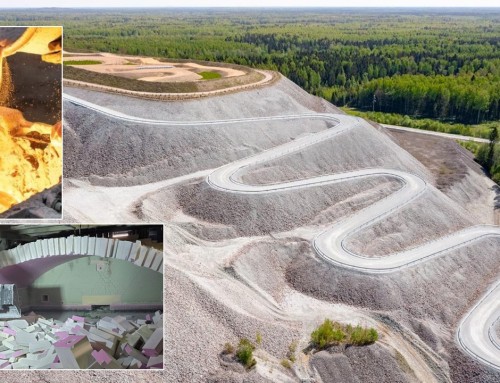
Title Image Bauxite Exposure Part of First Bauxite’s Bonasika bauxite mine in Guyana, one of the few refractory grade sources outside China, clearly showing the uniform layers of sand, clay, bauxite, and kaolin, each of which can be exploited for different markets. Courtesy FBX
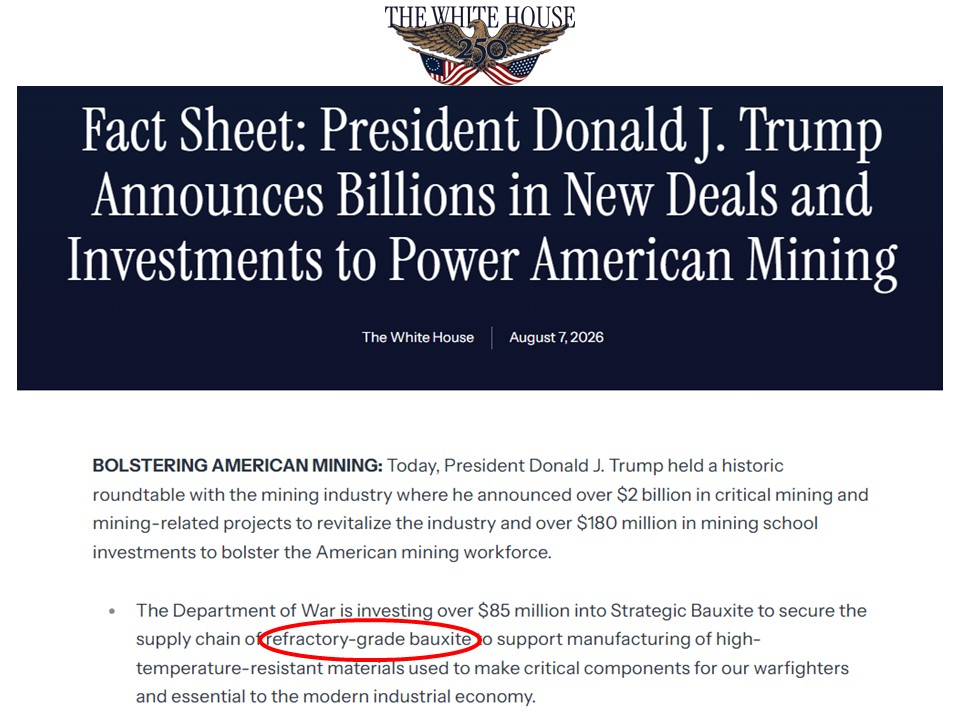 Notable was that refractory grade bauxite was mentioned by The White House Fact Sheet at all, and particularly in the context of funding “…critical mining and mining-related projects to revitalize the [US] industry…”, with apparent justification given as “…to support manufacturing of high-temperature-resistant materials used to make critical components for our warfighters [sic] and essential to the modern industrial economy.” (our underline).
At last, finally some appreciation for the importance of refractory minerals, in this case refractory grade bauxite (although it has not yet made the US List of Critical Materials), and perhaps a sigh of relief from the US refractory industry, challenged with importing overseas material from China. But there’s more to come.
Calciners for FBX and BFA plant for the USA
While precise details remain undisclosed, it seems the US Dept. of War input, with an additional reported US$64.5m in private-sector financing, is part of a wider package to support newly-formed Strategic Bauxite USA LLC to acquire First Bauxite LLC (FBX), expand its operations in Guyana, and set up a new brown fused alumina (BFA) plant in the USA.
In July 2026, Strategic Bauxite, described as a private investment holding company in the industrial critical minerals space, acquired FBX, owner and operator of a high purity bauxite mine and plant at Bonasika, Guyana – one the world’s few refractory grade bauxite sources outside China, which came on stream in just 2020 (see “Guyana bauxite newcomer starts bulk shipments”).
On 12 August, representatives of FBX, Strategic Bauxite, and critical mineral processor and recycler ElementUSA, met with Public Utilities and Aviation Minister Deodat Indar and other Guyanese dignitaries, to discuss the US$150m investment package to expand bauxite mining and processing in Guyana.
At present, FBX’s high grade bauxite is mined, washed, sized and exported from Guyana as raw, uncalcined bauxite. Some material is toll-calcined in the USA by independent processors, and also by ARCIRESA, at Lugo de Llanera, Asturias, northern Spain, and probably by consumers elsewhere as required.
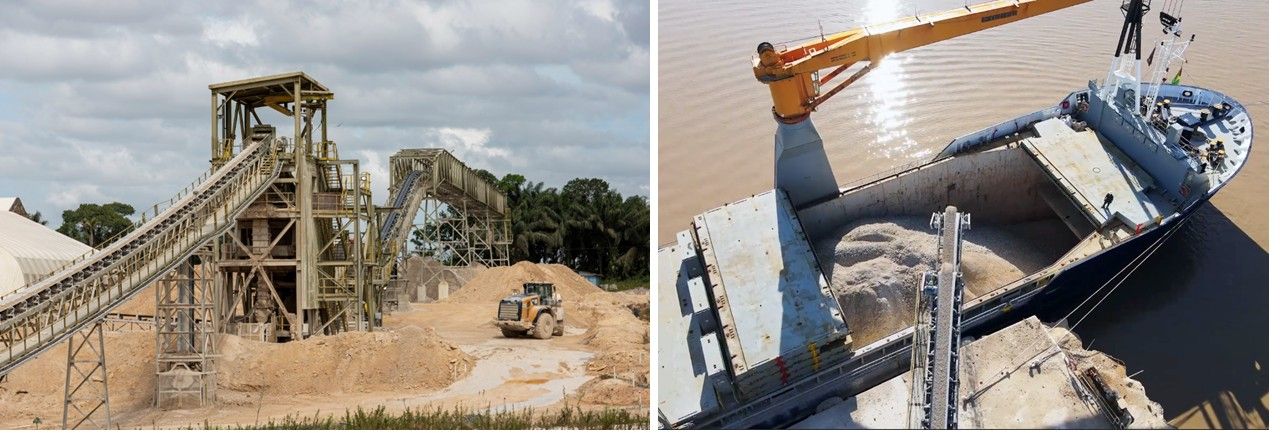
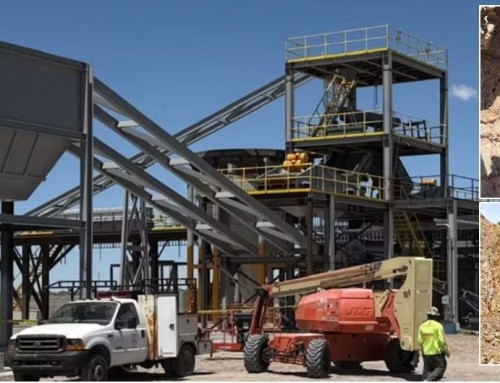
Conveyor system at the Bonasika bauxite mine, and raw bauxite being loaded at the Sand Hills storage and wharf facilities on the Demerara River. A calcination plant is to be added with this latest investment injection. Courtesy FBX.
For some time FBX has sought to secure its own calcining facilities, since this would certainly add value to the product and essentially avoid shipping moisture in its bauxite, but until now has been unsuccessful (in 2022 the company acquired ceramic proppant producer US Ceramics LLC, with rotary kilns in two plants in Georgia, however this did not work out; see “First Bauxite acquires US calcination plants”).
With this latest investment from the US government and Strategic Bauxite, it seems that FBX will finally gain its much needed calcination facilities on site in Guyana, which with rather good timing, is experiencing a boom in natural gas development.
So, not quite on-shoring refractory bauxite for US consumers, but at least near-shoring its supply.
The next silver lining for the US refractories sector from this funding package will be the construction and operation of a new brown fused alumina plant in the USA, whose bauxite feedstock naturally will be from FBX in Guyana. Initial indications point to Louisiana as the location for the new plant.
At present the USA has to import >95% of its fused alumina requirements, and mainly from China (BFA is also consumed as an abrasive).
In 2025, 20,000 tonnes of fused alumina was produced in the USA (from just two companies: Washington Mills Electro Minerals, New York, and Saint-Gobain Ceramics, Alabama), while imports totalled 150,000 tonnes (according to the US Geological Survey).
Attending the ICR26 next week in Aachen? Please drop by the IMFORMED stand for a chat and catch-up

Refractory bauxite in context: Chinese shortages ongoing
In Guyana, there is another, well established producer of refractory grade bauxite, Chinese-owned Bosai Minerals Group (Guyana) Inc. (BMGC) which has produced calcined refractory grades for many years (the refractory industry standard, “RASC” grade).
BMCG produces 5m tpa metallurgical grade bauxite, 450,000 tpa refractory grade bauxite, 200,000 tpa chemical grade bauxite, and 100,000 tpa of cement grade bauxite.
In 2024 Bosai initiated a major US$115m investment and commissioned a new rotary kiln #15 at its mining site in Linden, Region 10.
In the first quarter of 2026, Guyana’s total calcined refractory grade bauxite production was reported as 52,808 tonnes, up 27% from the same period of 2025. The Bank of Guyana explained the increase as “due to improved operational performance”. Total production in 2025 was 197,714 tonnes.
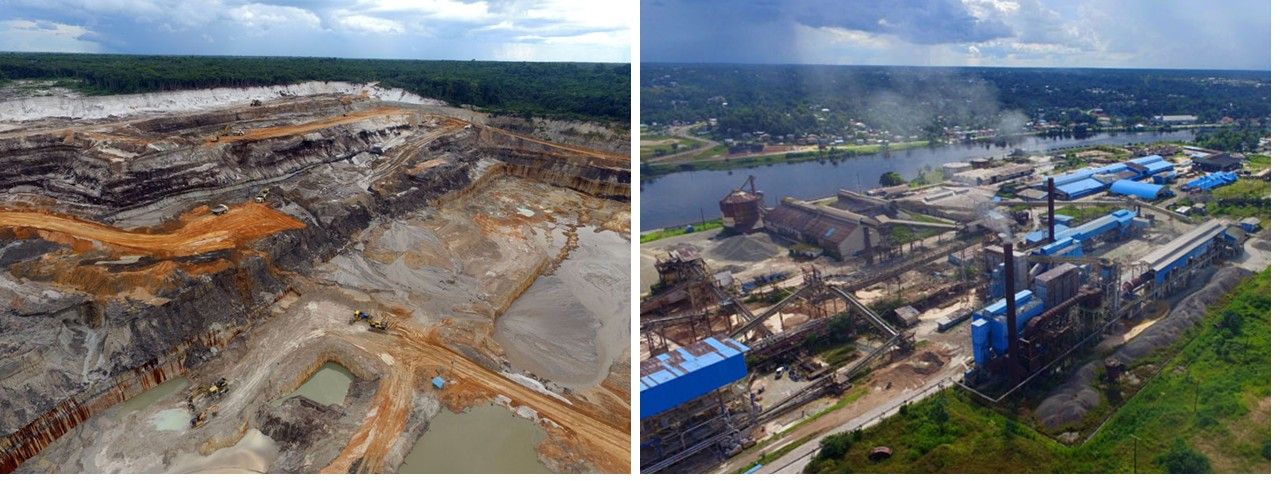
Two views of the extensive mining and processing operations of Bosai Minerals Group (Guyana), at Linden, which produces metallurgical, chemical, cement and refractory grades. Courtesy Bosai Minerals.
First Bauxite and BMGC in Guyana are the only commercially developed sources of refractory bauxite outside China. A new source is being developed by Bautek Minerais Industriais Ltda, in Goiás, central Brazil (see New dawn for Brazilian bauxite), which is the topic of a presentation by Paschoal Bonadia, Refractory Raw Materials Consultant, at next week’s ICR 2026, Aachen, 16-17 September.
In China, the main sources of refractory bauxite are in Shanxi, Guizhou and Henan provinces. However, in recent years the industry has been facing shortages of raw bauxite to feed calcination plants, owing to mining and exploration restrictions, environmental controls, as well as competing with demand for smelter grade alumina. This has negatively impacted production of Chinese calcined bauxite and fused alumina.
The situation is ongoing with mining operations in the Shanxi areas of Yuanping, Jiaokou, Linxian, and Qinyuan suspended with no clear timeline for resumption of operations. Chinese refractory bauxite plants are having to draw down fast depleting raw bauxite stocks, with some small and medium sized companies having to halt production. BFA production is reported as down to just 40% operating capacity.
Therefore, any development of alternative refractory bauxite and fused alumina sources outside China is much welcomed by the refractory industry, so this latest move by Strategic Bauxite and the US government is likely to be received with great interest.
Increased recycling of refractories, yielding alumina, bauxite and other refractory materials is now a very viable option as an alternative source.
Find out the latest trends and developments at…

US overreliance on refractory mineral imports
While these state funding announcements have been broadly welcomed by the US mining sector, the inclusion, and indeed recognition of industrial minerals has been somewhat scarce. Fluorspar, boron, phosphate and potash have been only recently added to the US List of Critical Materials, and as already mentioned, refractory bauxite has yet to be included.
Industrial minerals, of which refractory minerals are a significant category (20 or more different types), tend to be underestimated, or at worse ignored, as to their critical importance to manufactured industrial and everyday consumer goods.
Of course, once certain specialist and strategic end user sectors start getting mentioned – eg. defence, aerospace, electronics – then governments’ interest picks up (see “The crucial role of industrial minerals in defence & national security” by Nicholaus Rohleder).
As has been reported by IMFORMED, recent influencing factors on world trade in these minerals (eg. Covid-19, shipping crises, Russia-Ukraine and Iranian conflicts, China transformation) has sharpened attention as to the vulnerability of their supply chains.
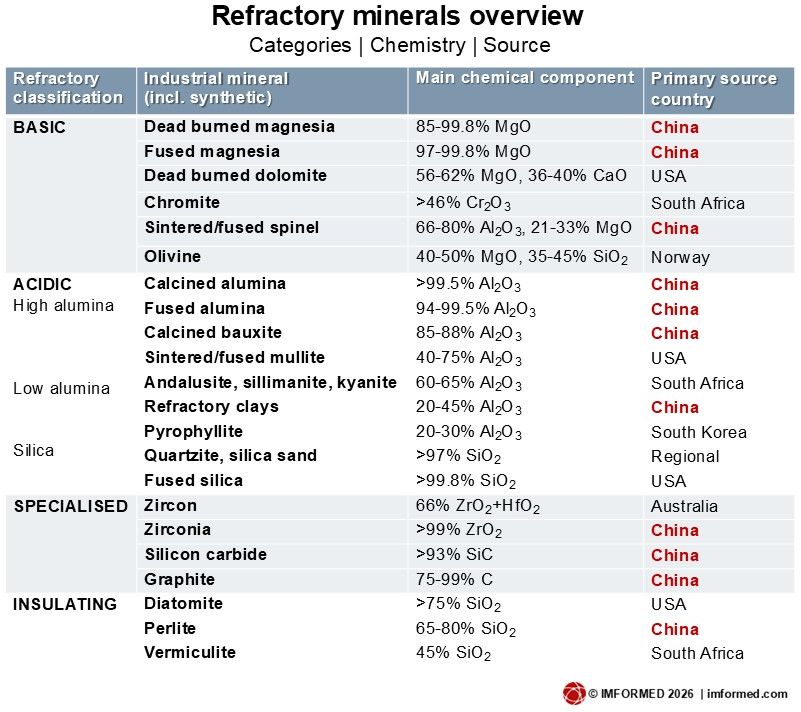
This is especially the case with regard to consuming markets’ overreliance on limited and in some cases diminishing overseas mineral sources – China looms large in this category. And here the world refractories market is a prime example. See below chart showing range of refractory minerals and their primary source countries.
The USA relies on significant import volumes of refractory minerals, particularly from China (according to latest data from the US Geological Survey):
- Bauxite, 100% (net import reliance), from China, Guyana
- Graphite, 100%, China, Canada, Mozambique, Mexico
- Fused alumina, >95%, China, Canada, Brazil, Austria
- Chromium, >79%, South Africa, Kazakhstan, Finland, Canada
- Silicon Carbide, 74%, China, Brazil
- Alumina, 71% from Brazil, Jamaica, Australia, Canada
- Magnesia, 52%, China, Israel, Brazil, Canada.
And for those interested in magnesia supply & markets…