
In the far north of Peru, more than 1,000km north of Lima, in the arid countryside near the port city of Paita, in Paita Province, lies an alluvial deposit of andalusite that is the world’s fourth largest producer, and one of the few independent suppliers, of the aluminosilicate refractory mineral.
In December 2024, following the ALAFAR 2024 Congress in Lima, this author was honoured to be invited to visit the operation by Carlo De Ferrari, General Manager, Andalucita SA.
At 40,000 tpa andalusite production capacity, Andalucita ranks as third largest andalusite producing company in the world after Imerys (in France and South Africa) and ARM Andalusite (South Africa; see map).

Exploration and evaluation of the Paita deposit began in 1997, and the project evolved, with much urging and steerage from geologist and refractory minerals guru Bill McCracken, through the early 2000s with the founding of Andalucita SA as a sister company of Refractarios Peruanos SA (REPSA) in 2006, and production commenced in 2009.

De Ferrari told IMFORMED: “We have alluvial material for about 60 years at the current plant capacity, and hard rock material for 153 years, also at the current capacity. The capacity at Paita changes according to the ore yield, but is about 40,000 tpa at the current yield.”
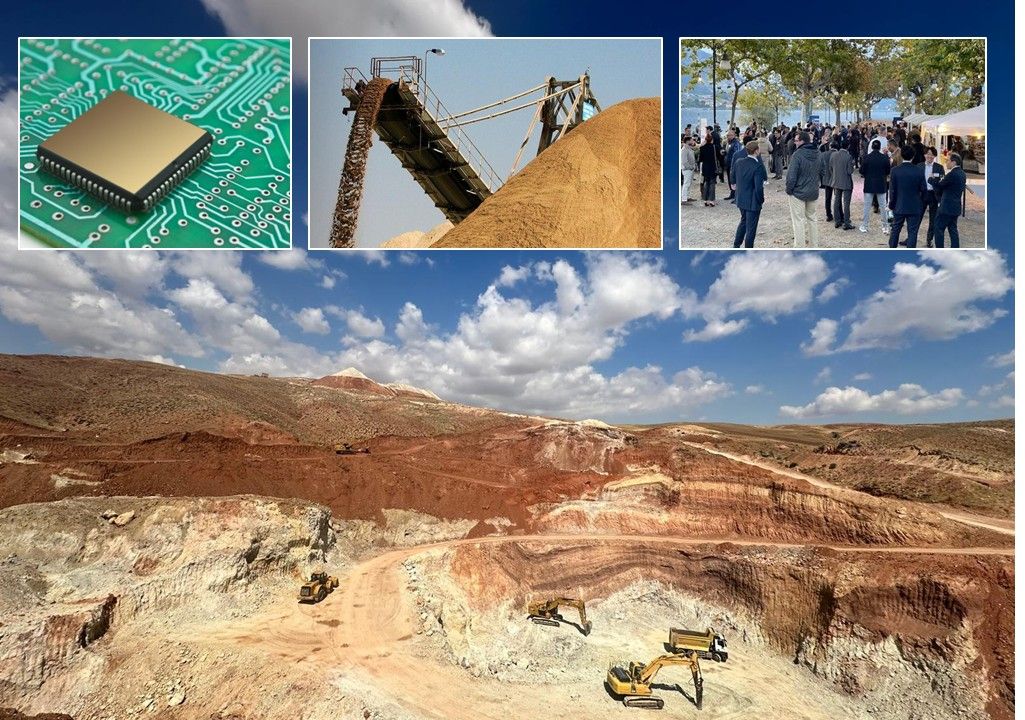
Using bulldozers and excavators, the andalusite ore is extracted in an open pit mine and transported by dump trucks 4km to the processing plant. A very high quality, homogenous deposit and easy extraction with minimal overburden are key advantages for Andalucita.

Andalucita’s mine near Paita, north Peru; (left) Mike O’Driscoll & Carlo De Ferrari with mine staff; (middle & right) easy extraction using bulldozers and trucks take ore 4km to plant.
The production process consists of the following stages:
Receiving alluvial mineral, separation and stripping
- Screening One (Coarse)
- Screening Two (Fine)
Production of mineral
- Crushing of ore via Barmac
- Separation of fine mineral
- Separation of quartz (Dense media)
- Mineral attritioning
- Dryer
- Magnetic separation
- Bagging and storage

Andalucita’s processing plant at Paita, involving screening, dense media separation, and magnetic separation.
“We have one of the lowest CO2 footprints worldwide, since we use hydro power for our production.” commented De Ferrari. Following the guidelines and methodology according to standard ISO 14067, in 2024 Andalucita achieved quantification of its product carbon footprint as being 0.1633 tCO2eq per one tonne of andalusite produced.
Andalusite is a unique refractory mineral, with different sources exhibiting different characteristics, ie. not all andalusites are equal, and developing the optimum process route suited to the respective deposit is absolutely key.
Andalucita provides grades typically of 58.5-59.0% Al2O3, low iron (<0.8% Fe2O3), coarse grain 1-4mm, 1-3mm, and 3-6mm sizes, and fine grain 0-1mm and 0.2-1.7mm sizes, which are used in refractory applications in steel, cement, glass, incinerators, aluminium and many other sectors.
“We export all over the world, however, there is a high use in Europe. Andalusite is sensitive to freight rates and other geopolitical factors, but the market is there and clients like to use our product due to the good quality” said De Ferrari.
Andalusite customised for refractories
The last 30-40 years have seen a see-saw in market demand for calcined bauxite and andalusite as the minerals compete in certain refractory applications, and when supply and price issues emerge for one or the other, their respective consumption is impacted.
At present, there remains a strain on supply availability for refractory bauxite which may play into andalusite’s hands. Whether the emerging squeeze (by expected EC anti-dumping actions) on fused alumina imports from China into the EU has any beneficial ramifications remains to be seen.
Historically there has been underdeveloped andalusite use in China owing to technological maturity, profitability constraints, and the availability of lower priced alternatives, mainly calcined bauxite.
However, this is changing, and market penetration is increasing (seen by andalusite imports to China) with a shift of steelmakers’ business models from cost to efficiency, also driven by the ongoing shortage of refractory bauxite.
In a paper presented at IMFORMED’s China Refractory Minerals Forum 2024, Chris Parr, VP Science & Technology, Imerys Refractories, Abrasives, Construction, France explained how required performance in terms of refractory properties can be tailored using different andalusite grades.
Andalusite with lower nominal alumina if correctly processed can deliver a superior performance than a higher alumina material (eg. 55-57% alumina). The mineral can also be a precursor for engineered materials, such as zirconia-mullite.
Andalucita is a Premium Marketing Sponsor of UNITECR 2025